Sri Lanka Transport Guide 2026: Driver vs Train vs Bus
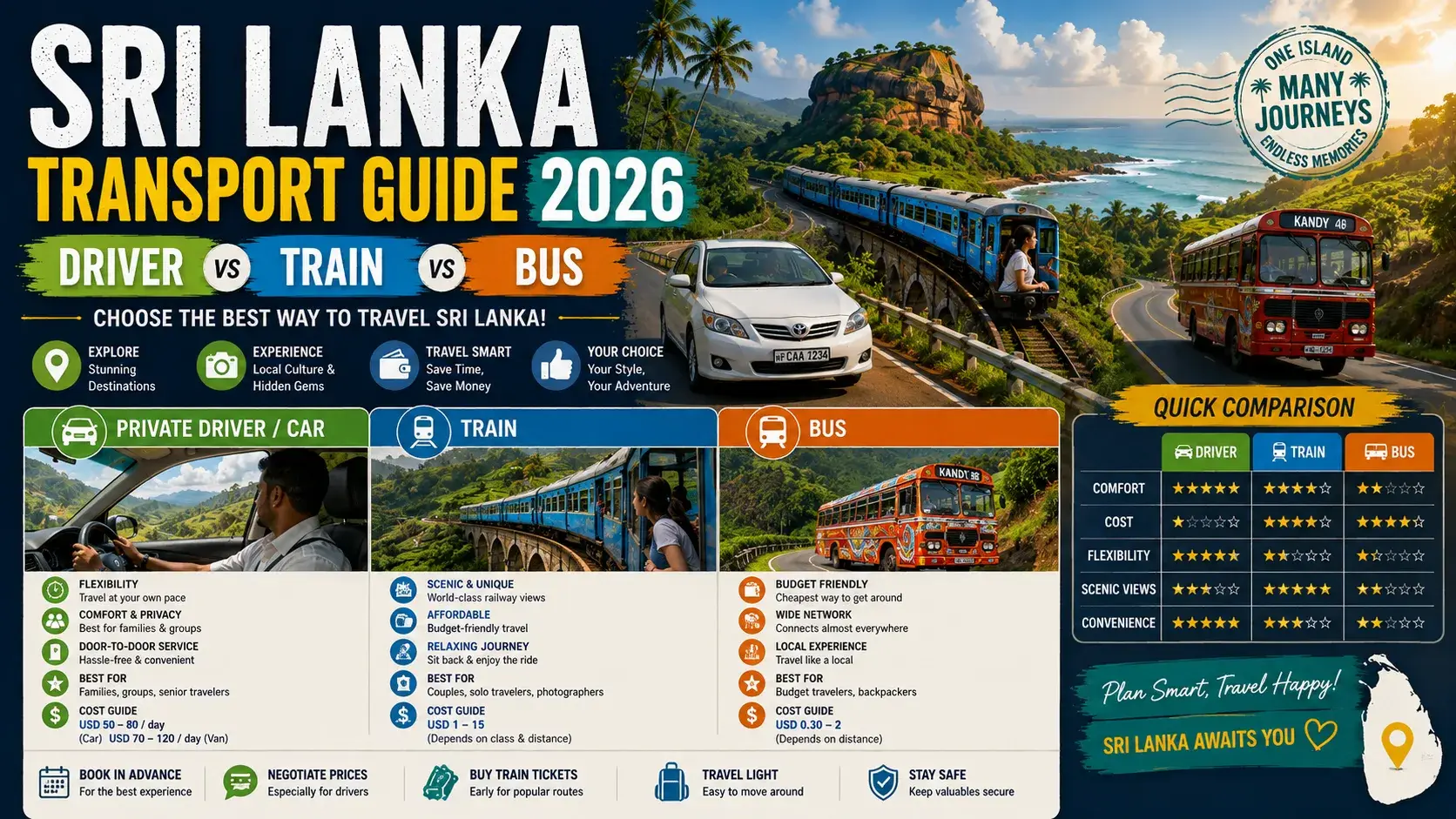
Getting Around Sri Lanka: Driver vs Train vs Bus
Sri Lanka’s roads are slow, its trains are scenic but limited, and its buses are cheap and chaotic. Most well-planned trips use a combination: a private driver for the loop, and the train for one or two legs where the journey is the point.
Quick Facts
- Average road speed: 30–40km/h outside expressways
- Private driver: $65–85 per day including fuel, tolls, and parking
- Train, Kandy–Ella: Around 7 hours, book weeks ahead in season
- Buses: Under $2 for most intercity routes
- Drive on the: Left
- Expressways: Colombo–Galle (E01) and Colombo–Kandy (E04) are genuinely fast
Private Driver-Guide — The Default Choice
For most visitors this is the right answer, and it is more affordable than it sounds. A driver-guide with an air-conditioned vehicle typically costs $65–85 per day, inclusive of fuel, expressway tolls, parking, and the driver’s own meals and accommodation. Split between two to four travellers it frequently beats the cost of individual transfers and taxis.
What you get beyond transport: stops wherever you want, luggage stays in the car, no timetables, local knowledge, and someone who handles the practical friction — finding lunch, negotiating a jeep at the park gate, knowing which entrance has the shorter queue.
How pricing works. Most operators quote a daily rate with an included mileage allowance — commonly around 100km per day averaged over the trip — and a per-kilometre charge beyond it. Pick-up and drop-off are usually expected to be in the same region.
Tipping is customary, at roughly $10–15 per day.
Trains — For the Journey, Not the Commute
Sri Lanka’s rail network is limited, slow, and in places spectacular. It is worth using for specific legs rather than as a general transport strategy.
Kandy to Ella is the famous one, and it deserves the reputation — around seven hours through tea plantations, tunnels, and hill country. Practical notes:
- Book reserved seats weeks ahead. 1st and 2nd class reserved sell out fast in high season.
- Unreserved 3rd class is always available and is how most locals travel — cheap, crowded, and often standing.
- Sit on the right-hand side travelling Kandy to Ella for the best views.
- Many travellers do only the Nanu Oya–Ella or Ella–Haputale section, which delivers most of the scenery in two to three hours.
Colombo to Galle along the coast is the other worthwhile run — slower than the expressway but much more interesting.
The catch: stations are often well outside town centres, and with luggage you will need a tuk-tuk at both ends. This is why the train works best as an add-on to a driver itinerary, with your driver meeting you at the arrival station.
Buses — Cheap and Genuinely Chaotic
Intercity buses cost almost nothing — usually under $2 — and go everywhere. They are also crowded, fast in a way that unsettles many visitors, and rarely have space for large luggage.
Two tiers exist: red government (CTB) buses, cheapest and most crowded, and private buses, marginally more comfortable and faster. Air-conditioned intercity express buses run the main routes between Colombo, Kandy, and Galle and are a reasonable option.
Good for short hops and for travellers on a tight budget. Poor for a multi-region itinerary with luggage.
Tuk-Tuks
The default for short distances. In Colombo, insist on the meter — metered fares are much cheaper than negotiated ones. Elsewhere, agree the fare before getting in.
PickMe and Uber both operate in Colombo and larger towns and remove the negotiation entirely. PickMe has better coverage outside the capital.
Self-Drive — Usually a Mistake
It is possible: you need an International Driving Permit validated by the Automobile Association of Ceylon, plus a recognition permit. Few visitors should bother.
Sri Lankan driving is assertive, lane discipline is informal, buses claim right of way by size, and hazards range from tuk-tuks to dogs to elephants. Given a driver costs $65–85 a day and removes all of it, self-drive rarely makes sense.
Scooters are a different question. Popular in Ella, Mirissa, and Arugam Bay for local exploring — check your travel insurance covers you, and wear a helmet.
Domestic Flights and Seaplanes
Cinnamon Air and others run seaplane and light-aircraft services between Colombo and points including Trincomalee, Batticaloa, and the hill country. Expensive, but they turn an eight-hour drive into 45 minutes — worth considering on a short trip with a long transfer.
The Combination That Works
For a standard 10-day loop:
- Private driver for the whole itinerary
- Kandy–Ella train as a scenic leg, with the driver meeting you at Ella
- Tuk-tuks for evenings and short local trips
- Expressway for the Galle–Colombo return, which is genuinely fast
Frequently Asked Questions
Q: Is a private driver worth it for two people? A: Usually yes. At $65–85 per day split two ways, it is comparable to taxis and transfers while being dramatically more flexible.
Q: How far ahead should I book the Kandy–Ella train? A: Reserved seats open around 30 days ahead and sell out within days in December–March. Book as soon as they open.
Q: Are Sri Lankan buses safe? A: Generally, though driving standards are assertive and accidents do happen. Air-conditioned intercity express services are the more comfortable option.
Q: Can my driver also act as a guide? A: Most driver-guides are licensed and knowledgeable. For detailed history at Anuradhapura or Polonnaruwa, a site-specific guide adds real value on top.
Q: What happens if I want to change the itinerary mid-trip? A: With a private driver this is usually straightforward — agree any change in mileage or route with the operator, as it may affect the final cost.
Continue Reading