Sri Lanka Weather by Month 2026: Monsoon & Season Guide
Sri Lanka Weather by Month & Monsoon Guide
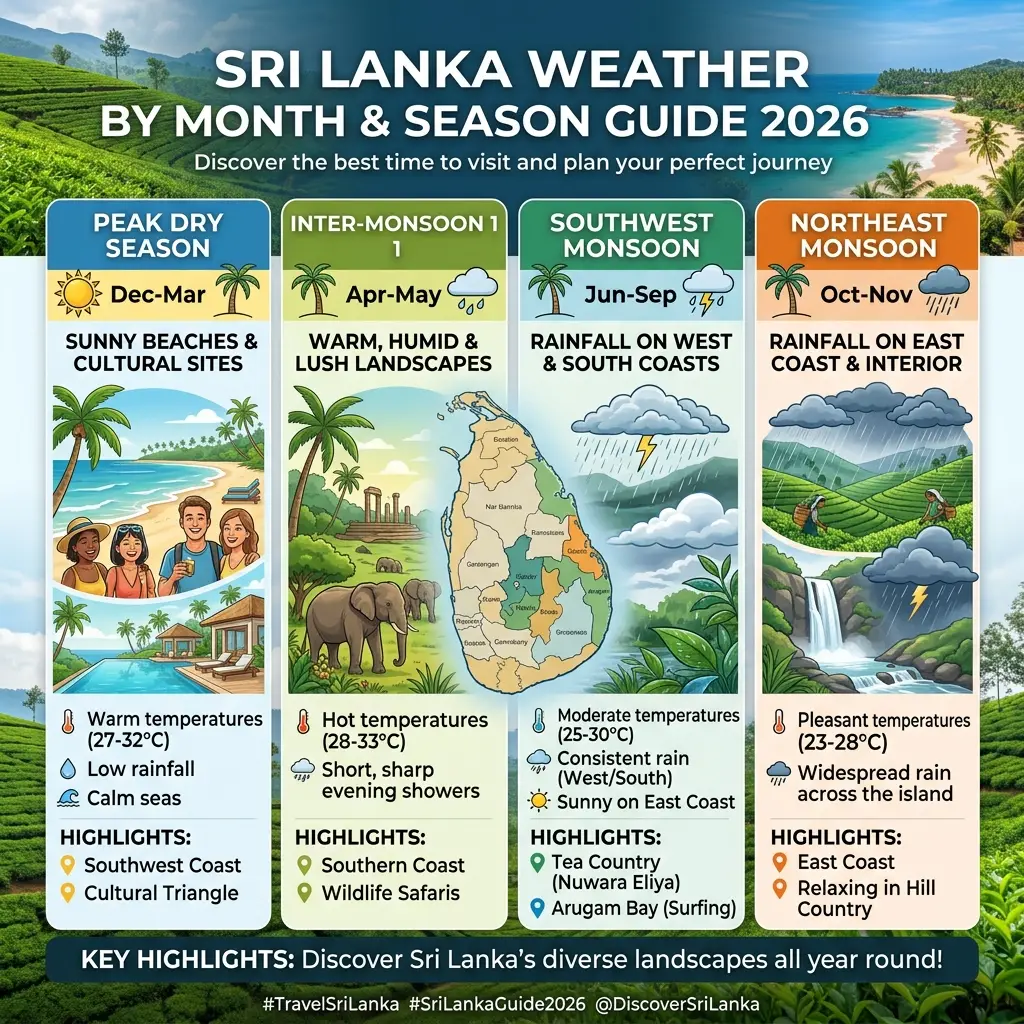
Sri Lanka has no off-season — it has two monsoons that hit opposite halves of the island at opposite times. There is almost always somewhere dry and sunny. The only real mistake is going to the wrong coast in the wrong month.
Quick Facts
- Yala monsoon: May–September, affects the southwest
- Maha monsoon: October–January, affects the northeast
- Inter-monsoon: October–November and March–April, brief afternoon storms anywhere
- Coastal temperature: 28–32°C year-round
- Hill country: 12–20°C by day, down to 5°C at night
- Peak tourist season: December–March
The Two Monsoons
This is the single concept that makes Sri Lankan weather make sense.
The Yala monsoon runs roughly May to September and brings rain to the southwest — Colombo, Galle, Mirissa, Bentota, and the western slopes of the hill country. While it rains there, Trincomalee, Pasikuda, Nilaveli, and the whole east coast are at their driest and best.
The Maha monsoon runs roughly October to January and does the reverse, soaking the north and east while the south and west coasts dry out into their peak season.
The Cultural Triangle — Sigiriya, Dambulla, Polonnaruwa, Anuradhapura — sits in the dry zone and is comparatively sheltered from both, which is why it works nearly year-round.
Month by Month
January. Peak season on the south and west coasts. Clear, dry, and busy. Excellent for Sigiriya and the Cultural Triangle. Cold nights in Nuwara Eliya. Northeast still wet.
February. Arguably the best all-round month. Dry across the south, west, and centre, with the clearest skies of the year for Sigiriya and Horton Plains. Whale watching off Mirissa is at its peak.
March. Still excellent in the south and west, gradually warming. The east begins to open up. Good balance of weather and slightly thinner crowds than January.
April. Hot, with inter-monsoon storms building. Sinhala and Tamil New Year mid-month means domestic travel surges and some businesses close. Whale watching season winds down.
May. The Yala monsoon arrives in the southwest. Rain increases on the south and west coasts. The east coast season begins — this is the month to switch your itinerary north and east.
June. Firmly east coast season. Trincomalee and Pasikuda are dry and calm. The southwest is wet but rarely all day. Good value; low tourist numbers.
July. East coast at its best. Minneriya’s elephant “Gathering” peaks — one of Asia’s great wildlife spectacles. Esala Perahera festival in Kandy usually falls in July or August.
August. Similar to July. Peak season for the east coast and for the Kandy Perahera. Dry zone wildlife viewing is excellent as animals concentrate around water.
September. The Yala monsoon eases. A good shoulder month — the east is still good, the south is improving, and prices are low.
October. Inter-monsoon. The least predictable month, with afternoon thunderstorms possible almost anywhere. The east begins to close down. Prices at their lowest.
November. The Maha monsoon settles over the northeast. The south and west coasts start drying out and the season begins to turn. Late November is often a good-value window before December prices.
December. Peak season begins in earnest on the south and west. Dry, sunny, and expensive — particularly over Christmas and New Year, when coastal hotels book out months ahead.
Choosing by Interest
- Beaches, south and west: December–March
- Beaches, east: May–September
- Whale watching (Mirissa): November–April, best in February–March
- Wildlife, Yala and Udawalawe: February–July, dry season concentrates animals
- The Minneriya Gathering: July–September
- Hiking and hill country: January–March for the clearest views
- Surfing, Arugam Bay: May–September
Frequently Asked Questions
Q: Is there a bad time to visit Sri Lanka? A: October is the least reliable, as the inter-monsoon can bring rain to both coasts at once. Even then, mornings are often clear.
Q: Does the monsoon mean constant rain? A: No. It typically means heavy downpours for an hour or two, usually in the afternoon, with sunshine either side. Whole washed-out days are unusual.
Q: Can I visit both coasts in one trip? A: Yes, but the drive between the south coast and the east is long. It works better on a two-week itinerary than a one-week one.
Q: How cold does the hill country actually get? A: Nuwara Eliya can drop to 5°C at night in December–February. Hotels rarely have heating, so pack a proper jacket.
Q: When is the cheapest time to go? A: September to November, between the two peak seasons, is when hotel rates are lowest across most of the island.
Continue Reading